Herzing NP clinical hours, by track
Your clinical hours are the precepted, in-person part of a Herzing nurse practitioner program: real patient care, supervised by a qualified preceptor at a Herzing-approved site. The exact number depends on your track, and the figures below are the ones commonly published for these programs. They are a planning reference, not a promise. Always confirm the exact requirement against your current Herzing handbook, because requirements change and your catalog year governs. This guide walks through hours by track, what counts toward them, and how they get logged. We are an independent placement service for Herzing students, not Herzing University.
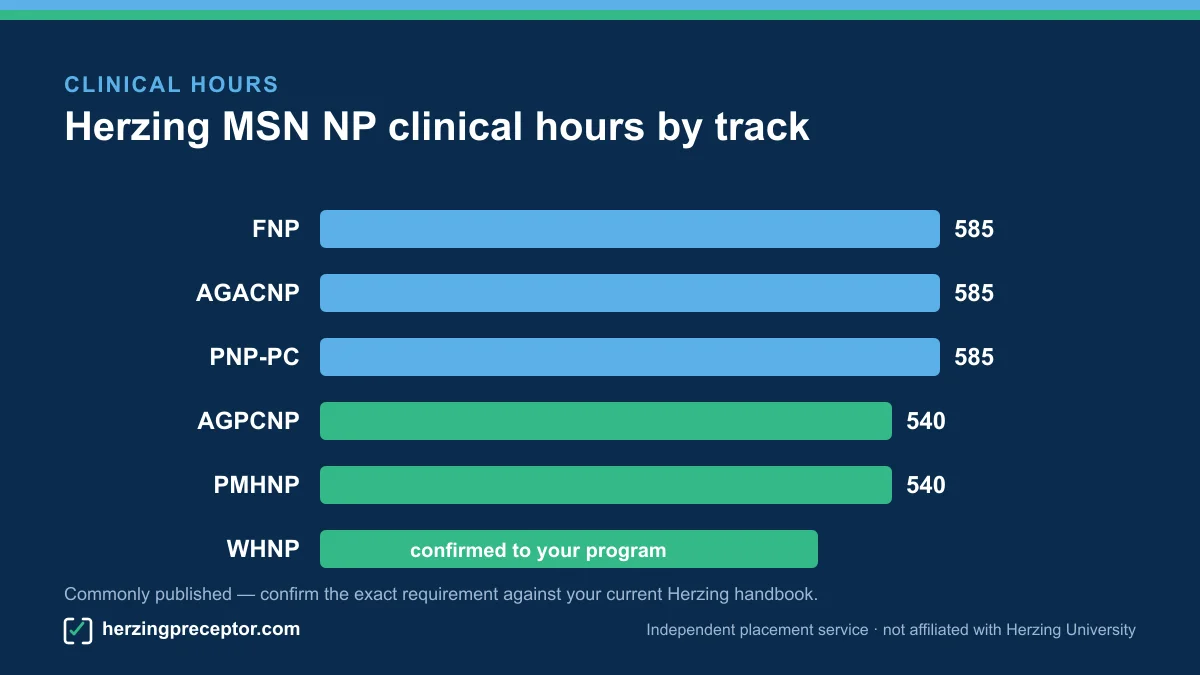
Hours by Herzing MSN NP track
Herzing's MSN nurse practitioner tracks carry semester-credit coursework (commonly 48 credits at the MSN level) plus a set number of precepted clinical hours you complete in person. The numbers below are commonly published for this program; we confirm the exact requirement against your current Herzing handbook before you build your plan.
- FNP (Family Nurse Practitioner), 585 clinical hours.
- AGACNP (Adult-Gerontology Acute Care), 585 clinical hours.
- PNP-PC (Pediatric Primary Care), 585 clinical hours.
- AGPCNP (Adult-Gerontology Primary Care), 540 clinical hours, which include a 180-hour, 16-week immersion.
- PMHNP (Psychiatric-Mental Health), 540 clinical hours, which include a 180-hour immersion.
- WHNP (Women's Health), hours confirmed against your program; we do not list a fixed number here because it should be verified against your current handbook.
A quick read of the pattern: the three tracks at 585 hours (FNP, AGACNP, PNP-PC) run a higher total, while AGPCNP and PMHNP sit at 540 and fold in a concentrated immersion block instead of spreading every hour across the term. The immersion is still precepted clinical time; it is just front-loaded into a focused stretch, which matters for scheduling because you and your preceptor need a window that can absorb 180 hours over roughly 16 weeks. If you are in WHNP, treat the hour count as an open question to resolve early with your program, not a number to assume. Post-master's APRN certificate students and DNP students should expect a different hour picture, covered further down.
These totals are a coursework reference. Your clinical deadlines determine when you actually start, and the math only works if your placement is locked in before those dates. That is the gap we plan around: lining up a Herzing-approvable preceptor in your specialty and state early enough to clear the deadlines, instead of leaning on a conditional backstop.
What counts as a clinical hour
A clinical hour is direct, supervised patient-care time at an approved site, performed under a qualified preceptor in your specialty. It is hands-on practice toward the competencies your track is built around, assessment, diagnosis, management, and the documentation that goes with real visits. The point of the number is contact with patients under supervision, not seat time.
Some activities that feel related usually do not count toward the precepted total, or count differently. Examples often excluded or capped include classroom and online coursework, independent study, skills-lab simulation, observation where you are not actively participating in care, and administrative time. Rules on simulation and indirect hours vary by program and by accreditation expectations, so this is exactly the kind of detail to confirm in your handbook rather than assume.
Two practical points students miss. First, hours have to be at a Herzing-approved site with an approved preceptor to count, time logged before approval is at risk. Second, your preceptor's specialty has to match your track; FNP hours need a primary-care fit, AGACNP needs acute-care, PMHNP needs psychiatric-mental health, and so on. Matching the preceptor to the track up front is part of why early placement matters. You can see how that lines up across all six specialties.
How clinical hours are logged
Hours are recorded in your program's clinical tracking system, the platform Herzing has you use to enter encounters and time. You log your hours as you go, typically tied to patient encounters or shifts, and your preceptor and faculty review and sign off. Keeping the log current matters: a backlog of unlogged time is hard to reconstruct and can stall verification near a deadline.
Alongside logging, your placement has to clear background check and immunization clearance requirements before you start seeing patients. None of those hours count until the site, the preceptor, and your own compliance are all approved, so compliance and logging move together. Plan to be cleared well ahead of your first clinical day so logging can begin on schedule.
One more habit worth building: reconcile your logged hours against your track's required total partway through, not just at the end. If you are running behind the pace needed to hit your track's total by your program's cutoff, you want to know with weeks to spare, not days. A preceptor who can offer consistent, sufficient patient volume is part of hitting the number on time, another reason to vet the placement, not just secure any placement.
DNP tracks and added practice hours
Herzing also offers a DNP, available BSN-to-DNP and MSN-to-DNP, with NP tracks in the same specialties. At the doctoral level, the NP practicum hours are joined by additional doctoral practice hours and a DNP Practice Project. So a DNP student's total clinical and practice-hour picture is larger than the MSN figures above, and it is structured differently.
Because the doctoral hour requirements layer on top of the NP track and depend on whether you enter from a BSN or an MSN, do not infer your DNP totals from the MSN numbers here. Confirm them against your current Herzing handbook and your specific entry point. The early-placement principle is the same: a Herzing-approvable preceptor in your specialty and state, locked in ahead of your deadlines, is what keeps both the NP practicum and the doctoral practice hours on track.
For how placement, deadlines, and the Clinical Placement Pledge fit together, see how clinical placement works at Herzing. We are an independent placement service for Herzing students, not Herzing University, and not affiliated with or endorsed by it. Our job is to close the timing gap so you reach your required hours instead of gambling on Herzing's conditional placement backstop.
Good to know
How many clinical hours does the Herzing FNP program require?
585 clinical hours is the figure commonly published for the Herzing FNP track. AGACNP and PNP-PC are also commonly listed at 585. Treat this as a planning reference and confirm the exact requirement against your current Herzing handbook, since your catalog year governs.
Why is the WHNP hour count not listed?
We don't publish a fixed WHNP number because it should be verified against your current handbook rather than assumed. If you're in the Women's Health track, confirm your required clinical hours with your program early so you can plan placement and deadlines around the real figure.
What's the 180-hour immersion in the AGPCNP and PMHNP tracks?
AGPCNP (540 hours) and PMHNP (540 hours) fold in a 180-hour immersion, a concentrated, precepted clinical block rather than hours spread evenly across the term. For AGPCNP this is commonly published as a 16-week immersion. It's still supervised patient care; it just needs a scheduling window that can absorb a focused stretch of hours.
Does coursework or simulation count toward clinical hours?
Generally no. A clinical hour is direct, supervised patient-care time at an approved site under a qualified preceptor. Classroom and online coursework, independent study, and most observation typically don't count toward the precepted total, and rules on simulation vary by program. Confirm what counts in your Herzing handbook.
How are clinical hours logged at Herzing?
You record hours in your program's clinical tracking system, usually tied to patient encounters or shifts, with preceptor and faculty sign-off. Hours only count once the site, preceptor, and your background check and immunization clearance are all approved, so keep your log current and start logging only after approval.
Get matched with a
Herzing-approvable preceptor
Tell us your track, your city, and your clinical application deadline. We'll come back with a placement plan and a realistic path to clearing it.