AGPCNP Preceptor Placement for Herzing Adult-Gerontology Primary Care Students
If you are in Herzing University's Adult-Gerontology Primary Care Nurse Practitioner (AGPCNP) track, your coursework is online but your clinical practicum is not. You need a qualified preceptor who practices adult and older-adult primary care, at a site Herzing will approve, lined up before your deadlines arrive. That is what we do. We are an independent placement service for Herzing NP students; we are not Herzing University and we are not affiliated with or endorsed by Herzing or the CCNE. Herzing wants you to lead your own search, and its placement backstop only activates after you have completed every step on time. We close the gap by finding an approvable AGPCNP preceptor early, so you clear Herzing's own requirements instead of relying on a conditional safety net.
What an AGPCNP preceptor does (and why the specialty match matters)
The Adult-Gerontology Primary Care Nurse Practitioner track prepares you to care for adolescents through the oldest old in a primary care setting: routine and chronic disease management, wellness and prevention, health maintenance, and the complex, layered conditions that come with aging. Your preceptor has to practice in that lane. A correct match is not a formality. It is what makes your hours count, what makes your evaluations meaningful, and what makes the site approvable in the first place.
For an AGPCNP practicum, the right preceptor is typically a board-certified AGPCNP or a physician (or other qualified provider) whose day-to-day practice is adult and older-adult primary care. Think family medicine practices that skew adult, internal medicine, geriatrics, primary care clinics, long-term care and assisted living, and outpatient chronic-disease management. The work is continuity and breadth across the adult lifespan, not a single organ system and not pediatrics.
Herzing reviews the fit before it approves anyone. The clinical application generally requires your preceptor's CV and a signed preceptor agreement so the program can confirm the provider's credentials and scope line up with the AGPCNP role. We screen for that match up front, so the preceptor we put in front of you is one Herzing can actually approve, not one you have to walk back later.
AGPCNP vs. FNP: a different scope, a different preceptor
This is the distinction students miss most often, and it has real consequences for who can precept you. The Family Nurse Practitioner (FNP) track is across the lifespan and includes pediatrics, women's health, and primary care for all ages. The AGPCNP track is adolescents through older adults only. It does not include pediatrics.
That single difference changes your sourcing. An FNP can often be precepted in a general family practice that sees children. An AGPCNP needs a preceptor and a patient panel centered on adults and older adults. A preceptor whose practice is heavily pediatric is the wrong match for your track, even if they are an excellent clinician, because the encounters will not map to your competencies. If you are weighing the two tracks or want to compare how placement differs, see our FNP preceptor page and the full list of specialties we place.
We sort this out before we approach anyone on your behalf. When you tell us your track and your state, we look specifically for adult and older-adult primary care settings, so you are not stuck mid-semester realizing the panel skews too young for your hours to count.
Clinical hours for the AGPCNP track
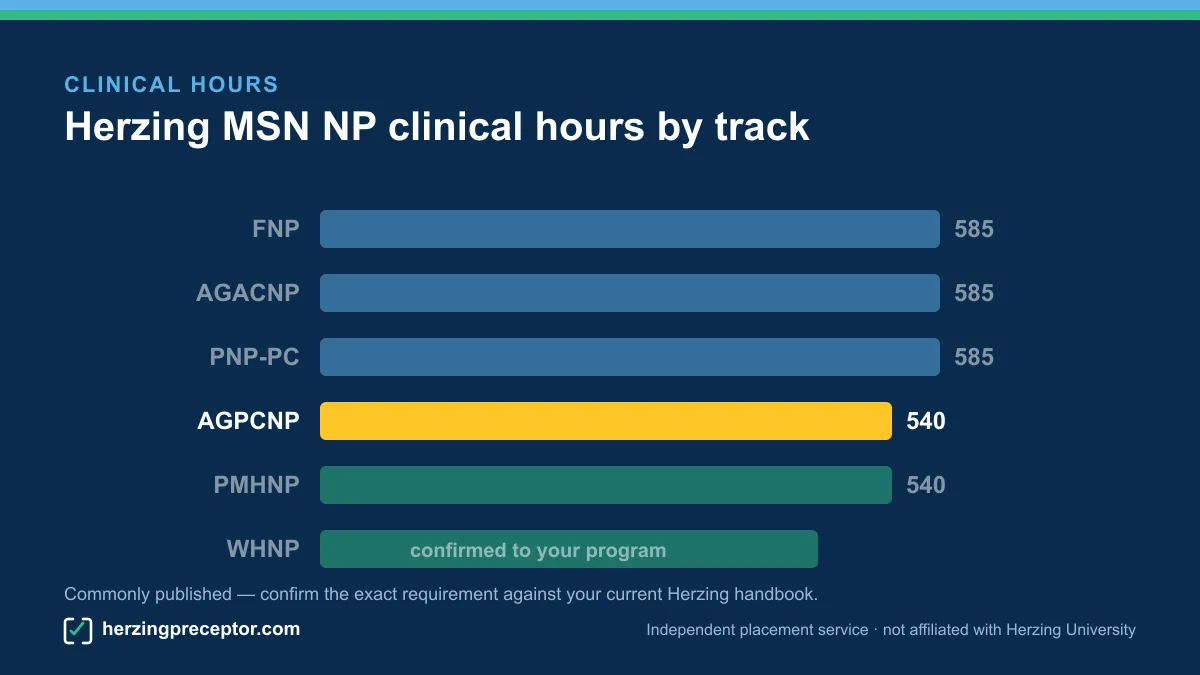
Herzing's AGPCNP track is commonly published with a concentrated immersion block built into the practicum. Treat any hour figure you see as the number commonly published for this program; we confirm the exact requirement against your current Herzing handbook, because requirements can change and the MSN and DNP paths carry different totals. If you are in a BSN-to-DNP or MSN-to-DNP path, your NP practicum adds doctoral practice hours and a DNP Practice Project on top of the master's-level expectations.
The immersion is worth planning around. A concentrated, multi-week block means you need a preceptor and site that can commit to sustained, regular hours over that window, not occasional days. That is exactly the kind of continuity a settled, early placement protects. When we source a preceptor for you, we factor in the immersion so the schedule is realistic before you start, not a scramble once the clock is running.
We keep the canonical hours breakdown in one place. For the per-track hours table across every Herzing NP specialty, including the AGPCNP total and its immersion, see clinical hours.
How Herzing's placement model actually works
Herzing is student-first by design. Students are expressly encouraged to take an active role in identifying and securing their own clinical site and preceptor. Herzing supports you with a Clinical Placement Advisor for guidance and a master's-prepared Clinical Coordinator for coaching and additional site leads, and it provides an approved-site fallback list if your own outreach does not land a placement.
Herzing also offers what it calls the APRN Clinical Placement Pledge: if, after completing all required steps on time, you still cannot secure a placement, Herzing will step in and secure it for you. That Pledge is real, and we want you to know it exists. It is also conditional, reactive, and deadline-gated, and every site and preceptor must be Herzing-approved. Read the conditions closely and the honest picture comes into view: the backstop helps you only after you have done everything correctly and on time, and only for approved sites.
One thing the Pledge is not: it is a placement backstop, not a tuition refund. There is no money-back guarantee anywhere in Herzing's model. The full explanation of the Pledge and its conditions lives on our clinical placement page, and the timeline detail for starting early lives on clinical deadlines.
How we source and approve your AGPCNP preceptor
Our role is simple and specific. We line up a qualified, Herzing-approvable AGPCNP preceptor in your specialty and your state, early enough that you clear Herzing's deadlines and approval requirements instead of gambling on the conditional Pledge. Here is what that looks like in practice.
- Specialty and geography first. You tell us your track (AGPCNP) and your state. We search for adult and older-adult primary care settings, screening out pediatric-heavy panels that would not fit your competencies.
- Credential and scope check. We confirm the preceptor's certification and practice align with the AGPCNP role, so the match holds up when Herzing reviews it.
- Approval-ready paperwork. We help you gather what the clinical application needs, including the preceptor's CV and a signed preceptor agreement, alongside the generic background-check and immunization-clearance steps and your program's clinical tracking system.
- Early, not last-minute. Because the Pledge requires you to start well before your deadline, we work to have a placement in hand ahead of that window. See clinical deadlines for the timeline.
One honest note on what we cannot promise. Herzing's Pledge is a placement backstop, not a tuition refund; there is no money-back guarantee in Herzing's model, and we make none either. What we offer is a real reduction in placement risk: an approvable preceptor in your specialty and state, secured early. If you want to start, tell us your track and location on our find a preceptor page or reach us through contact.
Good to know
What kind of preceptor do I need for the Herzing AGPCNP track?
A preceptor who practices adult and older-adult primary care, typically a board-certified AGPCNP or a qualified physician in internal medicine, family medicine with an adult panel, geriatrics, or an outpatient chronic-disease setting. The patient panel should run from adolescents through older adults. Unlike the FNP track, AGPCNP does not include pediatrics, so a pediatric-focused preceptor is not the right match.
How many clinical hours does the AGPCNP track require?
The AGPCNP practicum is commonly published with a concentrated multi-week immersion built in. Treat any number you see as the commonly published figure; we confirm the exact requirement against your current Herzing handbook, since MSN and DNP paths differ and requirements can change. See our clinical hours page for the full per-track breakdown and the AGPCNP total.
How is AGPCNP different from FNP for placement purposes?
FNP covers the full lifespan including pediatrics and women's health, so it can often be precepted in a general family practice that sees children. AGPCNP is adolescents through older adults only, with no pediatrics, so you need a preceptor and patient panel centered on adults and older adults. The scope difference directly changes who can precept you.
Doesn't Herzing's Pledge guarantee my placement anyway?
Herzing's APRN Clinical Placement Pledge is real, but it is conditional and reactive. It steps in only after you have followed the Clinical Guidance Process, met all deadlines, and started the formal placement process early, and only for Herzing-approved sites. It is a placement backstop, not a tuition refund. We line up an approvable preceptor early so you clear Herzing's own requirements rather than depending on the conditional backstop. See our clinical placement page for the full conditions.
Are you part of Herzing University?
No. We are an independent clinical-placement service for Herzing NP students. We are not Herzing University, we are not the CCNE, and we are not affiliated with or endorsed by either. We help you find and secure a Herzing-approvable preceptor; Herzing approves the site and preceptor through its own process.
Get matched with a
Herzing-approvable preceptor
Tell us your track, your city, and your clinical application deadline. We'll come back with a placement plan and a realistic path to clearing it.