Clinical Compliance and Onboarding for Herzing NP Practicum
Securing a preceptor is only half the battle. Before you can log a single clinical hour, you and your site have to clear a stack of compliance and onboarding requirements, and a single expired document can freeze an approved placement. This guide walks through what Herzing nurse practitioner students typically need to complete, how long it takes, and how to keep it from derailing your start date. We are an independent placement service, not Herzing University, so always confirm specifics against your current program handbook.
What clinical compliance actually means
Clinical compliance is the set of health, safety, and legal clearances that prove you are safe to see patients at a real clinical site. It is separate from finding a preceptor and separate from meeting your placement deadlines, but it gates both. You can have a willing preceptor and an open site and still be blocked from starting if your file is incomplete.
Two parties have to be satisfied. Your program needs every required item uploaded and verified before it will approve the rotation. Your clinical site often has its own onboarding on top of that, because the facility is letting a student into its building and near its patients. When the two sets of requirements overlap, you complete the stricter one. When they differ, you complete both.
Herzing's own materials do not name a specific clinical-tracking platform or a specific background-check vendor, and neither do we. Wherever this guide says your program's clinical tracking system or a background check, plug in whatever your handbook and clinical office actually specify. Do not assume a vendor you have heard of from another school applies here.
The typical requirements, item by item
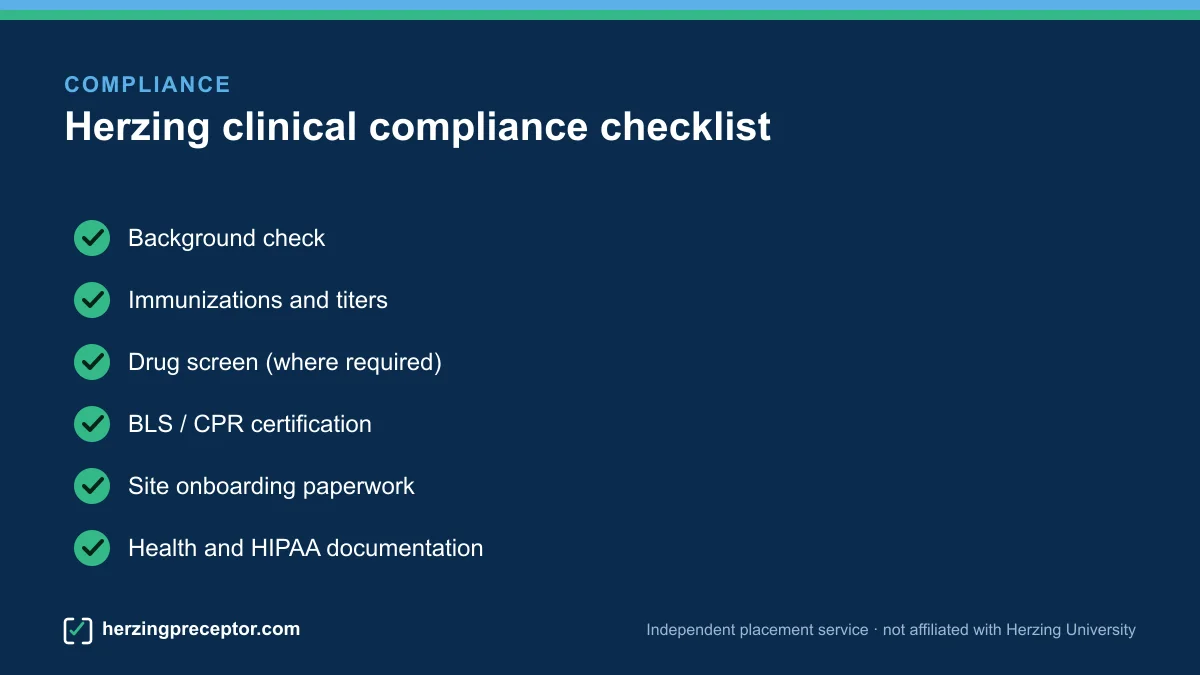
The exact list varies by track, state, and site, but most Herzing NP students see some version of the following. Treat this as a planning checklist, not a contract, and verify each item against your current Herzing handbook and your site's onboarding packet.
- Background check. A criminal background check, sometimes at multiple levels (county, state, federal). Some sites require it to be dated within a recent window, so an old one may not count.
- Immunizations and titers. Proof of immunity for common items like MMR, varicella, hepatitis B, and Tdap, usually documented by titer lab results rather than just a vaccination card. An annual flu shot and a current TB screen (skin test or blood test, sometimes a chest X-ray) are common.
- Drug screen. Many sites require a urine drug screen, often a multi-panel, completed within a set number of days before you start.
- BLS / CPR certification. A current provider-level CPR card, typically the kind that includes a hands-on skills check. Online-only certificates are frequently rejected.
- Health and physical clearance. A signed statement that you are physically able to perform clinical duties, sometimes including a recent physical exam.
- Liability coverage. Confirmation that you carry the malpractice/liability coverage your program requires for clinical students.
- Site onboarding paperwork. Facility-specific forms: HIPAA and confidentiality agreements, a signed code of conduct, EHR or systems access requests, badge photos, and sometimes a brief facility orientation.
- Preceptor documentation. Your preceptor's CV and a signed preceptor agreement, which your clinical application needs before the placement can be approved.
Some items expire. A TB screen, a drug screen, a flu shot, and a CPR card all have shelf lives, which is exactly where placements get stuck.
How an expired item stalls an approved placement
Here is the failure mode that catches people. You find a preceptor, your program approves the site, your start date is set, and then a compliance item lapses a week before clinical begins. Your CPR card was valid when you uploaded it in the spring but expires before the fall rotation starts. Your TB screen is now outside the site's acceptable window. The placement was approved, but you are no longer compliant, so you cannot begin until the item is renewed and re-verified.
Renewal is rarely instant. A new titer means a lab draw and a wait for results. A new drug screen means scheduling an appointment and waiting for the panel to clear. A new background check can take days to weeks depending on the jurisdictions involved. During that gap, your approved seat sits idle, and if the delay pushes you past a course census date, you can lose the term entirely.
The fix is to align expiration dates with your clinical start, not with the day you happened to complete the item. Before you submit anything, check how long each clearance stays valid and back-date the work so nothing lapses inside your rotation window. When in doubt, renew the cheap, fast items close to your start so they cover the full term.
A realistic compliance timeline
Compliance is not a one-week task. The slow items are the ones that depend on other people: labs, certifying agencies, background-check providers, and your site's onboarding office. Build the schedule backward from your clinical start date.
- 10 to 12 weeks out: Pull your handbook's current requirement list and your site's onboarding packet. Order titers and any missing immunizations first, since these have lab turnaround and may need a series.
- 8 weeks out: Begin the formal placement steps your program requires, and make sure your preceptor's CV and signed agreement are in hand. This window matters for more than compliance, which is why our deadlines guide stresses starting well before the clinical application deadline.
- 6 to 8 weeks out: Schedule the background check. Complete BLS/CPR if your card will not stay current through the term.
- 3 to 4 weeks out: Complete the drug screen and TB screen so they land inside the site's acceptable window. Finish facility paperwork, HIPAA training, and any access requests.
- 1 to 2 weeks out: Confirm every item is uploaded and marked verified in your program's clinical tracking system, and confirm the site has what it needs on its end.
If any item is rejected or returns a result that needs review, you want runway to fix it. The students who start on time are the ones who left margin for the one thing that went sideways.
How we keep your compliance moving
We are not Herzing and we do not run your compliance file, but the most common reason an approved placement stalls is timing, and timing is exactly what we manage. When we line up a qualified, Herzing-approvable preceptor in your specialty and state early, you get your required hours and your onboarding scheduled with room to spare instead of scrambling against a census date.
Because we secure the preceptor and confirm the site early, you learn the facility's onboarding requirements early too, while there is still time to order labs, renew a CPR card, or redo a screen that came back outside the window. We help you map each clearance's expiration against your start date so nothing lapses mid-rotation, and we keep the preceptor paperwork, the CV and signed agreement your application needs, moving in parallel.
Herzing's APRN Clinical Placement Pledge is real, but it is a conditional placement backstop, not a tuition refund, and it only steps in after you have completed every required step and started early enough to meet the deadline. That timing is the gap we close. See how the Pledge works and what we do to make sure you clear its conditions, then start with how our service works.
Good to know
Does Herzing require a background check and drug screen for clinical?
Most NP clinical placements require a criminal background check, and many sites add a urine drug screen completed within a set window before you start. The exact requirements depend on your track, state, and clinical site, so confirm them against your current Herzing handbook and your site's onboarding packet.
What immunizations do I need before my NP practicum?
Students commonly need documented immunity (often by titer) for MMR, varicella, hepatitis B, and Tdap, plus an annual flu shot and a current TB screen. Some items need lab turnaround, so order them early. Verify the precise list with your program and your site.
Do I need BLS or CPR certification?
Most clinical sites require a current provider-level CPR/BLS card with a hands-on skills check. Online-only certificates are often rejected. Make sure your card stays valid through your entire rotation, not just on the day you upload it.
Can an expired document really stop an approved placement?
Yes. Even after a site is approved and a start date is set, you cannot begin clinical if a required item, such as a TB screen, drug screen, flu shot, or CPR card, has lapsed or fallen outside the site's acceptable window. Renewals take time, so align expiration dates with your start date.
Which clinical tracking system or background-check vendor does Herzing use?
Herzing's published materials do not name a specific clinical-tracking platform or background-check vendor, and we do not either. Use whatever system and provider your handbook and clinical office specify, and do not assume a vendor from another school applies.
How early should I start clinical compliance?
Plan for 10 to 12 weeks. Order titers and immunizations first because of lab turnaround, then schedule background checks, drug screens, and onboarding paperwork so every clearance is verified before your rotation begins. Starting early also keeps you ahead of your placement deadlines.
Get matched with a
Herzing-approvable preceptor
Tell us your track, your city, and your clinical application deadline. We'll come back with a placement plan and a realistic path to clearing it.